Year 4
Welcome to Year 4!
Term 6
Please see the gallery for our topic web and optional home learning grid for this term.
In term 6, Badgers class will have PE on Monday and Friday.
Week 6
It's been a very warm week of learning in Badgers class!
English
This week we have been innovating our model text, 'The Journey'. We thought about different settings we could use and an object the main character could find that would be the start of their journey. We followed the five-part story structure and included the features we've studied.
Maths
This week we have been learning how to read and interpret pictograms, bar charts and line graphs. We also explored which types of graphs you would use for different kinds of data. For example, for continuous data, you would use a line graph.
Art
In art, we have been learning how artists use different pencil techniques to create texture in their drawings. We explored how varying the pressure, direction and type of marks can make a surface appear smooth or rough using only a pencil. We then applied these skills by experimenting with different ways to create the texture of a variety of hair types, using lines, shading and pattern to show curls, waves, straight hair and different thicknesses.
Week 5
English
This week in English, we have been studying our model text 'The Journey'. We looked at the five - part story structure: opening, build - up, problem, resolution and ending, and explored what each part should contain. We also identified the features of our model text to create a toolkit as a basis for what to include in our own writing.
Maths
We have been learning about money this week. We looked at the different coins and notes we have, and then practised converting between pounds and pence. We have also started to explore strategies to calculate with money.
Topic
This week in topic, we were given a list of food items which created a meal. We researched the country of origin of each item and how many miles it had to travel to get to us. We were then able to calculate the total number of food miles for a complete meal. We explored the impact food miles has on the environment, and discussed the reasons for and against importing food from other countries.
Science
It's a bit smelly in class this week! We've started our investigation into teeth enamel and the impact of different liquids on our teeth. We have used hard boiled eggs as the enamel and submerged them in different drinks/liquids. The children are already using their fantastic observation skills to see what happens to the eggs...we will draw conclusions from our observations next week.
Internet Safety
We were lucky enough to have a team from Google come and present to KS2 this week on how to use the internet safely considering the different elements we need to consider when being online. There is more information to explore here:
https://beinternetawesome.withgoogle.com/en_uk/
Week 3
English
We are studying journey stories this term in English. We have started by exploring the book 'Journey' by Aaron Becker. This is a wordless book. Have a look at the You Tube version here:
https://www.youtube.com/watch?v=JyBTnJcboWo
We have used our oracy skills to tell the story in our own words using the detailed illustrations to support our understanding. We also had a great discussion about the effectiveness of a wordless story.
Maths
We have started looking at time this week-converting between analogue and digital, including the 24 hour clock.
Look at these websites for practise at home:
https://mathsframe.co.uk/en/resources/resource/116/telling-the-time
https://www.topmarks.co.uk/time/teaching-clock
Science
We have started our new topic in science this week looking at the digestive system. Enjoy some of our clay teeth models in the gallery-we are able to identify and explain the roles of different human teeth.
Week 2
Well done to Badgers to approaching our Multiplication Check and assessments with a positivity and resilience this week!
English
We have studied characterisation this week thinking about how actions and description can help us understand more about a character. The Badgers have practised writing using these techniques. This will be great preparation for next week when start looking at a wordless story by Aaron Becker called 'Journey.'
Maths
This week in maths, we have been learning how to tell the time using both analogue and digital clocks. We have revised telling the time using minutes past and minutes to on an analogue clock, as well as reading 24-hour time on a digital clock. Can your child tell you what the time is during this weekend?
Spellings
We have been studying the morpheme 'image' this week and how we need to change this morpheme when adding prefixes and suffixes: image + nation = imagination. Use Spelling Shed to revise a range of rules to learn over the year please.
RE
A great end to our topic on Hinduism this week: the children completed independent research on Diwali and then used their presentation skills to present their findings to others in the class using great oracy skills. these included:
- A clear voice with change of volume for interest
- Eye contact with the reader
- Steady pace
- Using hands and actions to help
Topic
This week in topic, we learnt about farming in the UK. We learnt that arable farming is growing crops and pastoral farming is rearing animals. Many farms in the UK have both types of farming. We explored which types of land are most suitable for arable and pastoral farming, and explained the reasons why.
PE
A lively cricket lesson this week focussing on accurate throwing and fielding. Through a range of games, the Badgers honed their team work in fielding and quick reactions when fielding the ball-we have some great potential in class!
Week 1
WOW! What fantastic performances from all the Badgers in our class assembly-you ALL really impressed us with your oracy skills this week. Highlights include:
- Poetry recital with voice changes and expression
- Clear, projected voices
- Excellent timing in delivery
- Engaging singing performances
- Contributions from all the Badgers.
We are so proud that the Badgers stepped out of their comfort zones this week and the hard work really paid off. Pictures in the class gallery
Spellings-Lots more spellings added to Spelling Shed for this term; there are lots of revision words to recap and ensure embedded. Please keep working on these through the term.
Badgers class have worked really hard this week preparing their sharing assembly. We have been trying to apply some of the skills we have been learning in oracy, such as how to keep your audience engaged when you are sharing information with them. We have looked at the volume, clarity and intonation of our voice, our facial expressions and body language.
Maths
This week we have been learning how to describe and plot co-ordinates. Can your child explain to you which axis is horizontal and which is vertical? We have also learnt how to translate coordinates and shapes on a coordinate grid.
Multiplication Test Check
Next week (Wednesday–Friday), Year 4 will be taking their Multiplication Test Check. We are really impressed with the progress Badgers have made this year learning their times tables. Keep up the practise!
Week 6
Wellerman Song lyrics and links to youtube clips in HOME LEARNING for assembly practice.
This week has been Arts Week and Badgers class have thoroughly enjoyed it! Our theme this year was 'Under the Sea'.
Art
We started by looking at close-up features of animals, such as their eyes, scales, fins etc. We then chose an animal to create a 4-panel picture, each quarter containing a different close up of our animal.
Next we learnt about the artist, 'Dean Russo', who is an American pop portrait artist, known for his use of a mix of different bright colours in his artwork, which is predominately of animals. His works lie somewhere between realism and abstract colouring. We chose an animal to draw on A3 card, then we drew sections within our animal. Each section would be a different colour – we used oil pastels to make them bold and bright.
Maths
This week in our shape unit, we learnt about the different types of polygons, including types of triangles and quadrilaterals. We also looked at their properties, including parallel lines, perpendicular lines and symmetry. Can your child explain what these properties are?
Please try to keep up the times table practise over half term. If you go onto the 'Soundcheck' area on TTRockstars, you can do a 25 question times table test, similar to the Multiplication Test Check that Year 4 will be completing next term.
English
This week we focused on how to describe a setting – our setting was a storm at sea. To begin, we listened to the music composed by Benjamin Britten, 'Storm' from 'Four Seas Interlude'. We also looked at some clips of storms at sea and made notes about what we could see, hear and what we imagined it would feel like. We explored different similes, adjectives and powerful verbs we could include in our description.
Week 5
English
This week we have been working hard writing our own explanation texts and publishing them on the laptop. We learnt a lot about Microsoft Word too – we will be doing some more work on this in computing next term!
Maths
We have started a new unit this week – shape. We have learnt how to describe angles as a turn and the different types of angles: acute, right angle and obtuse. Can your child explain these angles to you?
Two weeks until the Multiplication Test Check. Keep up the times table practise - every little helps!
Topic
This week we learnt about how rice is grown and exported from Indonesia. We also looked at how rainforests are being cut down and turned into farm land, which is called deforestation. We discussed some of the problems this may cause, such as plants and animals losing their habitat and how it contributes to global warming.
PE
Badgers class are really enjoying their tennis sessions in PE. We have been working on our aim and control with a racket and ball.
Science
Great discussions about biodiversity and deforestation this week and last week. There is lots of interesting information about how charities such as WWF help habitats across the world if the children are interested in this issue:https://www.wwf.org.uk/learn/effects-of/deforestation
RE
We have continued thinking about what life in Britain is like for Hindus. This week we used drama to learn the story of Rama and Sita and how this story teaches Hindus about Dharma.
More can be found here: https://www.bbc.co.uk/bitesize/topics/zh86n39
Week 4
A week of lots of exciting learning this week; some things challenged our resilience but the Badgers dug deep and were truly AWESOME!
English
The Badgers have started writing their own explanation texts...we have REAL processes (for example, the digestive system and frog life cycles) as well as fictitious processes (how dragons breathe fire!). We are looking forward to seeing the finished work next week and publishing them on laptops too.
Maths
Some more great work on decimals-ordering and rounding to the nearest INTEGER...can Badgers explain what this word means?! The children have looked at the integers before and after a decimal number to show how to round up or down.
Drama
We were lucky enough to have a drama teacher in this week to do a session with KS2-it was based on Alice in Wonderland so the class got so much out of it after studying it earlier in the year. See the gallery to see some fabulous freeze frames they created-look at those expressions!
Music and PE
We were lucky enough to do some combined learning with year 5 today in PE and music. The children learnt some songs using sign language to celebrate Deafness Awareness Week and we became sprinters just like Usain Bolt in PE-great team work across the classes too!
Week3
Lots of great learning in Badgers this week!
English
This week, we have been studying our innovated explanation text, How Do Dragons Learn to Fly?, and writing our own versions. In our writing, we have included key features such as formal language, adverbials of time, and causal conjunctions.
Maths
We have continued with our learning of decimals this week. We have looked at how many tenths and hundredths make a whole, how to partition decimals and when we need to use zero as a place holder.
Please keep up the times table practise! Remember to use this website to practise the upcoming multiplication test:
https://mathsframe.co.uk/en/resources/resource/477/Multiplication-Tables-Check
Topic
This term, our topic is 'Food for the Future'. So far, we have learnt about the Northern and Southern Hemispheres and we have started to investigate the different climates around the world and the type of food that grows in them. This week, we looked at a farm in Kanas, USA. Here, they have a temperate climate - which is similar to the UK's. We learn how wheat is produced and the kind of foods it is used to make.
Art
We have been learning about shading in art this term. We have experimented with a range of techniques, such as cross-hatching, scrumbling, stippling and blending. Our next step is to apply these techniques to our own compositions.
Science
This week we have got outside and started to look at how we can CLASSIFY plants using a classification key. What aspects of plants allows us to sort them? Some great careful OBSERVATION skills to ensure we can see their differences! Check this out for more information:
https://www.bbc.co.uk/bitesize/articles/zdt2jsg#z6y22v4
Spellings
This week we have explored the suffixes able and bile: The children now know that if we add ABLE the root needs to be a word on its own DEPEND + ABLE = dependable and if we add IBLE, it is not POSS + IBLE = possible.
Week 2
A busy week of learning in Badgers.
Spellings
This week we are focussing on the 'sion' suffix. We add this when the root words ends in d, de or se. We remove these letters and add sion: invade = invasion. See Spelling Shed for practise and the sheets in the spellings file too.
Science
We have been focussing on classification keys-developing accurate questions to classify animals in detail. The children have grown in confidence in defining animals by vertebrates, invertebrates, exoskeletons, arachnids and insects.
Computing
Badgers are studying picture editing tools this term. The first two weeks have focussed on cropping, rotating and using a range of effects to change the meaning/mood of a photo. Perhaps the Badgers can have a go at practising these skills at home on laptops or tablets? We would love to have some sent into the class email to share in the next lesson. Look in the class gallery at some of our results!
French
This term we are looking at how to have more in depth conversations with others. We have practised different ways to greet others and explain how we are feeling and asking each someone their name. This is a focus on fluency and sustaining a conversation-some great accents in the Badgers too, well done!
Maths
We are working on hundredths as decimals and fractions this week. Use this link to consolidate and practise:
https://www.bbc.co.uk/bitesize/articles/zsbd7p3#zr6hkhv
English
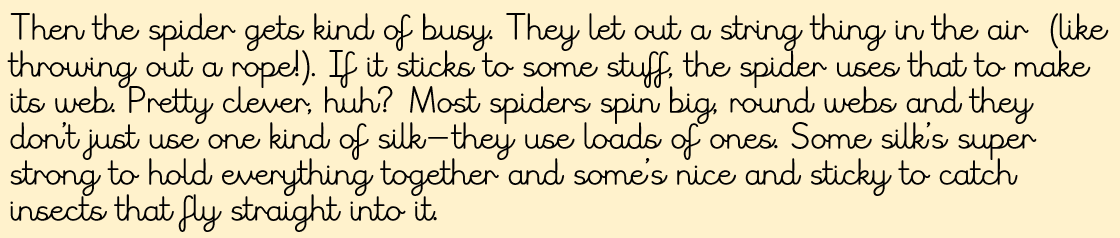
We are focusing on the different features of an explanation text this week. We have studied the difference between FORMAL and INFORMAL tone. Our explanation text needs a formal tone: no slang, no contractions, serious and technical language
Look at this informal writing-can you make it more formal? The children did a brilliant job of using technical vocabulary in class to do this!
Week 1
A great start to our learning for term 5 Badgers!
English
We are learning a new type of text in English-Explanation Texts. We discussed how their purpose is to explain a PROCESS, often linked to science.
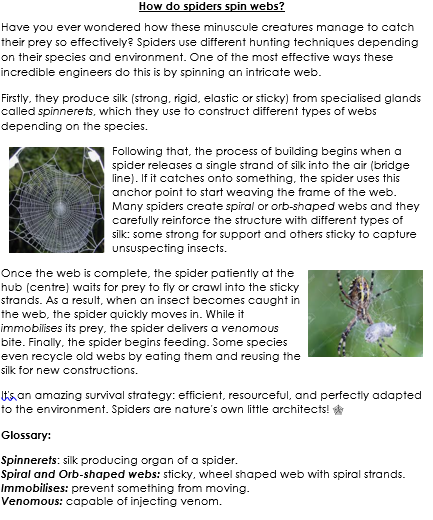
We are learning an explanation text about how spiders build their webs. We have been exploring the technical vocabulary in the text...can you ask the children to explain the words 'spinneret' and 'orb' to you? We have been looking at the PURPOSE of this text and how it helps others to learn about the process.
Have a look at the text together at home too:
Spellings
This week we are looking at the 'le' suffix as in battle and struggle and 'al' as in focal. We have an attached a sheet to practice in the spellings folder in the class gallery as well as some practise work on Ed Shed-we have also put some practise of the year 3/4 tricky words list-please practise these too this term.
Times Tables
Please continue to practise your multiplication facts. Use this website to help and adjust the questions to the times tables your child needs most help with. Remember: RAPID RECALL is what we are aiming for. All the children are making good progress but a few facts are still alluding them-we know they can do it-GO FOR IT BADGERS!
https://mathsframe.co.uk/en/resources/resource/477/Multiplication-Tables-Check
Maths
Over the next few weeks we are looking at decimal numbers-see if the children can spot decimal numbers around them...measurements are a good place to start!
Term 4
Week 5
Science
Wow! We've had a fab morning at Icknield today to finish off our science topic on Electricity. The children managed to get water to bend with static electricity; make a range of circuits; demonstrated how we are human conductors (through the water in our bodies) and worked with a Van de Graaff generator to generate static electricity! So many great questions and understanding shown too. Check out the pictures in our gallery.
Week 4
Author talk – Watlington Library
We were very lucky to be invited to our local library to listen to author Sue Palmer talk about her new book 'The Shell Secret'. We learnt about her upbringing in Cornwall (where the story is set) and about some of the animals you find at the seaside. Lots of children in the class have a copy of her book - we can't wait to hear some reviews!
English
This week, we have explored our innovated transformation myth, 'Narcissus and Echo'. We have also started to plan our own myth, which contains all the features we've learnt during this unit.
DT
We read the Greek myth 'Theseus and the Minotaur', where Theseus has to find and defeat the Minotaur, who is kept in an elaborate labyrinth. We designed our own labyrinth and made it out of cardboard and straws. We used marbles to try and find our way through a friend's maze. Have a look in the gallery for some photos!
Topic
This week we compared the Ancient Greek city-states Athens and Sparta, which were very different. Athens was an intellectual centre with thriving philosophy, art, and architecture, as well as the first true system of democratic government. Sparta was centred around training and perfecting its military, which was strong and effective.
Week 3
A busy week of assessments, but also lots of engaging learning too!
Music
Badgers have been studying the beats in a bar this week and looking at the information that helps them understand this in music notation. They also practised being conductors keeping the beat-it is harder than it looks! Some excellent recorder playing too with a very quick piece. Hopefully it will be coming to an audience soon!
RE
Badgers enjoyed exploring images of Hindi deities this week, using observation skills to understand similarities and differences. They also learnt about what each deity represents and how clues about their appearance helps us understand this.
Science
Badgers are beginning their investigations for the STEM competition that we enter each year. This year we are exploring how to make a working switch for a miniature theatre linked to our work in Greek myths in English-applying their knowledge of conductors and insulators will be crucial!
English - This week we've been learning about how to 'show not tell' a character's feeling. This means describing a character’s actions, expressions, body language or thoughts instead of directly stating their feelings. It helps the reader work out how the character feels rather than being told. For example, instead of saying - Sam was nervous before the race, you could write - Sam’s hands trembled as he tied his shoelaces. He kept glancing at the starting line and took a deep, shaky breath.
Maths - We have started to learn about improper fractions - they are a type of fraction that represents a quantity greater than one whole. In an improper fraction, the numerator (top number) is equal to or larger than the denominator (bottom number). This tells us that we have more than one complete whole.
Topic - This week we learnt about how democracy started in Athens in Ancient Greece. The Ekklesia were the main group of people, who assembled about 40 times each year and decisions would be made by a majority vote. The Boule were a smaller group who decided which issues should be taken to the Ekklesia. The Dikasteria dealt with crimes and legal matters. They were chosen randomly each day and would decide if someone should be tried and what their punishment should be.
Computing - We've really enjoyed learning about programming using 'FMSLogo' on the laptops. We learnt how to input commands to draw different shapes in various colours. We used this to create patterns – have a look in the gallery for some photos.
Week 2
A fantastic week of learning including a book filled World Book Day!
World Book Day
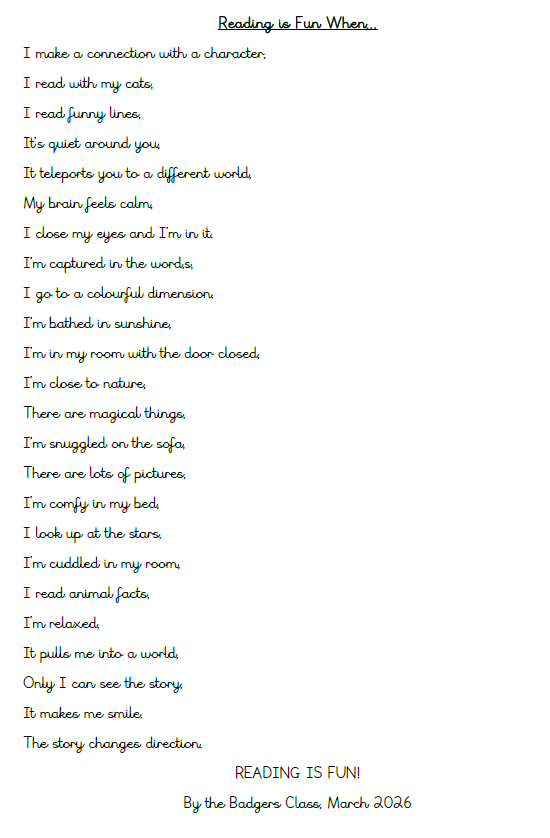
Enjoy some photos of our day in the gallery. It was a fantastic day celebrating the 'fun' of reading. We explored different books, improved our book corner with book reviews, character and book bunting and art that represented the books we love. We enjoyed a story telling game in nature; we all chose one natural object and used it to help tell a team story-they were very creative and went in all sorts of crazy directions! We also composed a class list poem about when reading is fun and it was read beautifully by some Badgers in assembly too. Here it is for you to enjoy:
Science
Our second week on exploring circuits in our Electricity topic. The children have explored how to create open and closed circuits as well as examining what are good INSULATORS and CONDUCTORS. Lots of excellent questions around energy flow and even static electricity. Great job Badgers!
English
We have started exploring our model text, the Greek myth of 'Arachne and Athena'. This is a transformation where a character is transformed as punishment for behaviour and character flaws-can you find any other stories that follow this pattern?
Maths
A week exploring fractions on a number line and considering the order of different fractions and how to estimate when a fraction may be placed on a number line. We have also looked at square numbers and the children have learnt some actions to help recall them all up to 12 x 12.
Week 1
Remember 'World Book Day' is next week - Thursday 5th March!
English - We have started our new fiction unit in English this term, which focuses on stories that contain a change and have a moral. We will be linking these to Greek myths. We have completed our 'cold task' and next week we will be learning the story of 'Arachne and Athena'.
Maths - We have started a new unit on fractions this term. We started by recapping some of the key vocabulary and concepts of fractions. Can your child explain to you what the numerator and denominator are?
Our focus on times tables is continuing – keep up the practise!
Topic - Our new topic for the term is 'Ancient Greece'. This week we learnt where Greece is located and key information about its geography. Did you know Greece is a peninsula because it is surrounded by sea on three sides?
STEM workshop - On Wednesday, we had a guest come into school to talk to us about STEM careers (science, technology, engineering and mathematics) where we learnt about all the different jobs you can do within STEM. We were then put into teams and were given a specific contraption to design. For example - build a machine that stays in the ocean collecting plastic and is environmentally friendly. Finally, we presented our invention to the class.
Term 3
Week 6
English - This week, we independently wrote our own discussion text. We tried to ensure we gave a balanced argument and used all the features we have learnt during this unit. Can your child verbally explain to you what they wrote about?
Maths - This week we have been learning about finding the perimeter of 2d shapes and how to find missing lengths, using the information we have been given.
Well done for everyone's hard work learning their times tables, we've seen some great progress! We are continuing to work on this next term - keep up the practise!
Topic - We have really enjoyed learning about Oxford this term! This week, we learnt how to read maps using four figure references. We learnt that the numbers going across are called 'Eastings' and the numbers going vertically are called 'Northings'.
Next term, we will be learning about Ancient Greece.
Week 5
Badgers class trip – We had a great time on Wednesday in Oxford! We started our day at the Museum of Oxford, where we participated in a workshop which looked at how the city of Oxford grew around its transport, the people involved and how this may change in the future. We studied maps of Oxford and got to handle historical artefacts. We also got time to look around the museum, which displays information and artefacts detailing Oxford's history. There were lots of interactive activities there, we particularly enjoyed dressing up in old-fashioned clothes and digging up historical remains!
After a break for lunch, we walked down to Christ Church (thankfully the weather was on our side – we even had some sun!). We walked around the grounds, then found a spot to sit down and do some landscape sketching.
Well done Badgers class for a great trip!
Have a look on our gallery for some photos.
Week 4
English – This week in English we have been focusing on using paragraphs correctly and how to use fronted adverbials in discussion texts. We looked at using adverbials to show the order of ideas, e.g. firstly, secondly, finally and using adverbials to show the other side of the argument, e.g. on the other hand, however, although etc.
Maths - We have started to learn about area this week, which is the total space taken up by a 2d surface or shape of an object.
We are still continuing to focus on our times table recall - keep up the practise!
Art - This week we learnt how to draw a landscape with perspective, by using the horizon line and the vanishing point.
Computing - We have started a unit on programming this term, using the software 'FMSLogo'. We learnt some basic commands that enabled us to move the pen forwards, backwards and turn left and right. We experimented with different commands to see which shapes we could create.
Week 3
English - This week in English we have identified the different features of a discussion in our model text and we have explored how to use the conjunctions: however, although and despite. Can your child use these in a sentence?
Maths - We have been learning the compact written method for short multiplication this week. It's been a good opportunity to practise our times table recall! Can your child explain the method to you?
Topic - This week we have been learning about the journey of a river and how they are formed. We learnt that the source is the place where the river begins and that as the river flows through the land, they change shape and size due to erosion. The wide part of the river near the sea is called an estuary. The mouth of the river is where the tide meets the river's stream. Next week we are going to look more closely at the River Thames.
Art - We have been learning about how to use perspective in our landscape pictures. We explored how to use the horizon line and vanishing point to create a 3d landscape.
Science
We have been exploring how sound waves travel differently through air and solids and using this to explain how string telephones work. Lots of excellent observations by Badgers including noticing the sound was more muffled; the looser the string, the quieter the sound and the shorter the string, the louder the sound.
Poetry by Heart
We have begun learning our poems for this competition-Badgers have brought their chosen poem home-please help them to practise at home if possible and we will be having more sessions learning in class too-they are very inspired by it!
Week 2
English - This week we have been looking closely at our model text. We have created a story map to help us remember the text, explored some of the vocabulary and 'boxed up' the text, which helps us understand what each paragraph should contain.
Maths - This week we have been multiplying and dividing by 10 and 100. When we multiply, the digits move to the left once for 10 and twice for 100. When we divide, the digits move to the right.
We were really impressed with how much progress some of the children made with their times table recall this week - keep it up!
Topic - In topic this week, we have been learning about human and physical features. A human feature is something that has been created by humans (such as buildings, roads ect.), whereas a physical feature is something natural (such as rivers, mountains etc.) We explored the physical and human features in Oxford and considered why these made Oxford a desirable place for people to settle in the past and present.
Art - In art this term, we are learning about painting and landscapes. This week, we learnt about tints (adding white to a colour) and shades (adding black to a colour). We also explored different ways to use the paintbrush to achieve different effects. Have a look in our gallery for some photos!
Week 1
English - We have started our new writing unit, which is discussion texts. During this, we will be learning how to present a balanced argument, discussing both sides fairly, then giving our own opinion at the end. For our 'cold' task, we wrote a balanced argument about whether children should do online learning if we have a snow day (no such luck yet!). What do you think?
Maths - This week we have been learning about factors. A factor is one of two or more numbers that divides into a number without a remainder. For example, 10 is a factor of 30 since 30 divided by 10 is 3. However, 10 is not a factor of 27 because 27 divided by 10 is 2 with a remainder of 7. We are also learning the relevant vocabulary: factor X factor = product. We have also learnt the term 'commutative'. Multiplication is commutative because you can change the order of the numbers and still get the same answer (same as addition).
Topic - In topic this term we are doing a local study of Oxford. For our first lesson, we looked at the difference between a continent, country and county. Can your child explain the difference to you?
Times table challenge - To help motivate the children to learn their times tables, we are doing a weekly multiplication challenge. This will focus on how many new facts they have learnt and increasing the speed of their recall. Any support you can give your child to help them learn these will be much appreciated!
Term 2
Roman Day!
Badgers class had a brilliant Roman day – everyone looked great in their costumes! We had a debate about whether Boudicca was a villain or hero, made Roman honey biscuits and got to look at real Roman artefacts, where we tried to work out what they were and who would have used them. We really enjoyed sharing our learning with our families and showing them some army formations with the Roman shields we had made in DT. Have a look in the gallery for some photos!
Week 4
English - This week we studied our innovated newspaper report, based on Boudicca's rebellion against the Romans. We also discussed how to create a headline that will grab the readers' attention and including the 5 W's (who, what, when, where, why) in the opening paragraph.
Maths - This week we have been exploring the relationship between the 3, 6 and 9 times tables. How does knowing the 3 times table help you with the 6 and 9 times tables? Remember to keep practising at home!
Pantomine - Badgers class really enjoyed our annual pantomime, 'Dick Whittington' at the Oxford Playhouse. There was lots of singing and dancing and audience participation!
Art - We made our own Roman inspired mosaics. Have a look in the gallery for some photos.
Week 3
English – This week we've been focusing on some of the grammatical features of a newspaper report. We have learnt about subordinating conjunctions, using direct quotes, writing in a formal tone and using the past tense.
Maths – We've been busy starting our assessments in maths this week! We have started to look at the 9 times table, in relation to the 3 and 6 times table. How does knowing your 3 times table help you with the 6 and 9 times table?
Oracy - Badgers class have been really enjoying their 'Talk Tuesday' oracy sessions. Each week we have a different question to discuss. We are currently focusing on 3 areas of a discussion: instigating, building on and challenging other people's points. This week our question was: If you had 24hrs to travel to either the past or future, where would you go and why?
Week 2
English – We've been looking closely at the structure and features of a newspaper article. We have written our toolkit of features, which includes: headline, the 5 W's in the opening paragraph (who, what, when, where and why), witness quotes, conjunctions, third person, formal tone and past tense. Remember to bring in any good examples of newspaper articles if you have any at home.
Maths – This week we've been looking at fact families and bar models in relation to multiplication and division. For example:
6 x 4 = 24
4 x 6 = 24
24 ÷ 6 = 4
24 ÷ 4 = 6
We are focusing on the 3 and 6 times table at the moment. Remember to keep practising these at home!
Topic – This week we learnt about Boudicca's rebellion in 60 AD. The Iceni tribe rebelled against the Romans as they tried to take over their land after Boudicca's husband's death. They took advantage of the Roman legions being in North Wales and they set to overthrow Roman rule. Although they didn't succeed, they did destroy the town of Colchester and then went onto ransack London and St. Albans. We discussed both Boudicca's and the Roman's point of view. Were the Iceni tribe right to rebel?
Week 1
A great week back to school!
English-Badgers are starting to study newspaper reports this term-please bring in any good examples of news articles that the children might like to share in class. We are learning a model text all about the Roman invasion of Britain and focussing on the features of newspaper reports.
Maths- Over the next couple of weeks we are working on multiplication facts and how to apply these to problem solving. Keep practising the quick recall of these facts...we have a challenge coming this term to help the children learn them!
Remembrance-Well done Badgers on being part of the School Remembrance assembly and sharing a poignant poem written by a teenager for the Festival of Remembrance. Thank you Hector, Issy, Amelia and Anna for reading it so beautifully.
Term 1
Week 2
Coding session
We had a great session today, using 'MakeCode Arcade'. Firstly, we learnt how to create our own sprite and set a background for a game. We then learnt how to make the code to control our sprite and we experimented with some of the variables. See our gallery for some photos.
Science
We started exploring 'States of Matter' this week. Badgers enjoyed exploring solids, liquids and gases to classify them accurately. There were lots of good questions and observations: "What state are bubbles?" (Rufus), "is corn flour and water a solid or liquid?" (Maria). We will have to do some investigating further next week...
Music
Badgers had their first lesson with Mrs Andrews-they loved playing Beat Master, trying to work out who had started the beat in different ways-some Badgers had eagle eyes and were very speedy!
PE-Rugby
We FINALLY managed to fit our rugby lesson in between the showers! Excellent running, passing and team work-it was great to see lots of skill progression in just one lesson!
Nest
We enjoyed making (and tasting!) apple crumble this week in the Nest, being careful with using the knife to cut apples up, and mixing oats and flour to make a crunchy topping. See the class gallery for some photos!
Week 3
Another great week Badgers!
English-Badgers have practised using fronted adverbials, expanded noun phrases and sentences of three to create vivid descriptions for a reader-watch this space next week for some examples!
Science-WOW! We learned all about Ooblek this week and how it behaves like both a liquid and a solid- ask the children all about it!
K-Nex
Badgers have started to experiment with how K-Nex can be a brilliant learning tool. Check out our initial trials in the gallery...
Week 4
A very busy week in Badgers!
Day of languages
Some wonderful engaging learning across the different languages studied. We were really impressed with the pronunciation in Spanish and enthusiasm to have a go! Enjoy the greetings fortune tellers they bring home.
Maths
Badgers developed discussion skills in maths this week, explaining to each other the errors they can see in ordering 4 digit numbers...ask your badger to explain the mistake in this ascending order:
2352 3215 452 5216 6127
English
Some powerful descriptive language used in our setting writing in a metropolis... see some examples in our gallery.
Art
In art we have been learning about the architect and designer from Spain, Antoni Gaudi. His designs were inspired by the beauty of nature and he pioneered a special mosaic technique called Trencar, which is still used today.
Week 5
Maths
This week we have been learning to round to the nearest 10, 100 and 1000, using a helium balloon! Ask your child if they can explain how using a helium balloon can help with rounding numbers.
English
We have been writing our own opening to a warning/journey story. It has three parts: opening, character and build-up. Can your child tell you their story?
Topic
This week, we have learnt about what daily life in ancient Rome was like. We looked at their technology, hygiene, life as a child, houses and food. Did you know they used urine to wash their clothes!?
Science
Great exploration of changes of state this week! We examined and explored the terms MELTING, FREEZING, EVAPORATING and CONDENSING. Can the children explain to you about these processes and the temperatures that water freezes and boils? Could they try freezing some different liquids-what happens?
Week 6
Maths
This week, we have recapped the compact written method for addition, including exchanges. We've discussed different strategies to mentally add single digits together, such as applying our number bonds to 10 and using our double/near double number facts. Can your child explain the written method to you using the question below:
4568 + 3266
English
We are really enjoying our new unit on Limericks! After reading lots of different examples, we identified the features. We looked at how many syllables each line contained and the rhyming pattern. Can your child explain the features to you?
We also learnt and performed a limerick to the class. Can your child still remember it?
Topic
This week, we learnt about the rise of the Roman Empire and the geographical spread of the Roman influence. We discussed why the Romans wanted more land and why they were successful at achieving this.
Week 7
English
We've been examining the features and themes of Limerick poems this week. We really enjoyed exploring rhymes and finding our own rhyming words. We are now planning and writing our own Limericks - we can't wait to share them with you!
Maths
This week we have been learning the compact written method for subtraction with exchanging. Can your child explain the method to you using these questions:
7629 - 3472 8427 - 5236
Topic
Last week we learnt about the geographical spread of the Roman Empire. This week, we focused on how the Romans invaded Britain. Did you know it took three attempts for them to succussfully invade Britain?
Computing
We have been exploring if we can trust everything we read online. How do we now if a story is true? These are some of the questions we considered to help us: